
Dollar Bill Dimensions: A Comprehensive Guide With Facts And Figures
The dollar bill dimensions have continued to be consistent for practically a century, but comprehending these specifications provides more than mere trivialities. For collectors, educators, business owners, and the inquisitive public alike, these measurements furnish valuable insight into the blueprint of American money.
This guide supplies a thorough analysis of dollar bill dimensions. We will investigate accurate measurements, historical changes in standardization, contrasts with international currencies, and plenty of intriguing facts about the cash you carry every day.
How Tall Is A Dollar Bill?
To streamline these dimensions, consider a customary U.S. dollar bill: the dollar bill size in inches is just over 6 inches in length and 2.5 inches in height, making it marginally longer but constricted than a credit card.
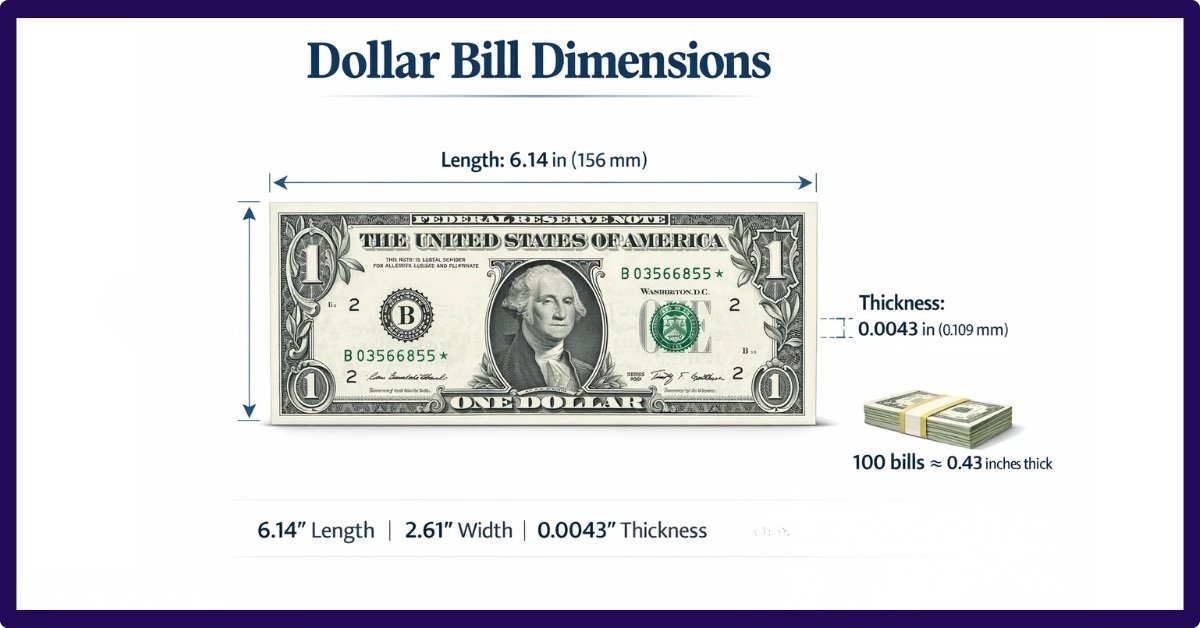
| Dimensions of a US Dollar Bill | Length | Width | Thickness |
| Dimensions Of Dollar Bill In Inches | 6.14 inches | 2.61 inches | 0.0043 in |
| Dimensions Of Dollar Bill In cm | 15.6 cm | 6.6 cm | 0.011 cm |
| Dimensions Of Dollar Bill In mm | 156 mm | 66 mm | 0.11 mm |
In metric terms, this is 15.6 cm by 6.6 cm. A pile of 10 bills achieves a thickness of roughly 1 millimeter, while 100 bills measure nearly half an inch. These dollar bill dimensions measurements are useful for everything from school projects to fashioning custom display cases.
How Big Is A Dollar Bill?
A U.S. dollar bill measures 2.61 inches wide, 6 inches to 6.14 inches long, and about 0.0043 inches thick. While barely bigger than a routine playing card, its dimensions are analogous to common everyday items; it is minutely wider than a credit card and as much as the same length as most present day smartphones. This concise size makes the currency extremely easy to stack and store.
Dollar Bill Dimensions And Dollar Bill Size
Beyond their fiscal value, U.S. dollar bills are noteworthy for their consistent and uniform dimensions, which have remained practically unaltered since 1929. This uniformity serves a pragmatic purpose, facilitating proficient stacking and flawless processing in banks and automated teller machines.

While many nations issue currency in numerous sizes, the United States preserves a consistent layout to ensure clarity and ease of recognition.
100 Dollar Bill Dimensions Cm
Concerning the dimensions of the $100 bill, the note measures 15.6 centimeters in length and 6.6 centimeters in width. Designed for convenience, these magnitudes permit the currency to be carried effortlessly, while the bill maintains a thickness of about 0.011 centimeters, or 0.11 millimeters.
Dimensions Of A Dollar Bill
The dimensions of a customary U.S. dollar bill have remained homogenous since the currency redesign of 1929. Understanding these dimensions supplies insight into the functional design choices that expedite the everyday handling and storage of paper money.
Dollar Bill Width and Dollar Bill Height
A U.S. dollar bill measures 2.61 inches (roughly 6.6 centimeters or 66 millimeters) in both width and height. This standardized size makes certain that all denominations are consistent, allowing for seamless stacking and a comfy fit in most wallets without the need for folding.
Dollar Bill Length
The length of a dollar bill is 6.14 inches (around 15.6 centimeters or 156 millimeters). This exact measurement is constant across all U.S. paper currency, making sure that money remains mobile and fits accessibly into pockets and purses.
Dollar Bill Thickness
Each bill is nearly 0.0043 inches (0.11 millimeters) thick, which is equivalent to the thickness of a few stacked sheets of paper. This sleek profile is indispensable for durability and allows individuals to carry substantial sums of cash succinctly and efficiently.
Conclusion
Essential for everyday commerce, the standard U.S. dollar bill dimensions measures 6.14 inches in length and 2.61 inches in width. Crafted from a durable blend of cotton and linen, these dimensions have remained consistent since the currency redesign of 1929.
Familiarity with dimensions of a dollar bill is vital for efficient cash handling, compatibility with wallets and automated machines, and the maintenance of production uniformity, which serves as a critical deterrent against counterfeiting.
FAQs
How Long Is A Dollar Bill?
A standard dollar bill is about 6.14 inches long.